





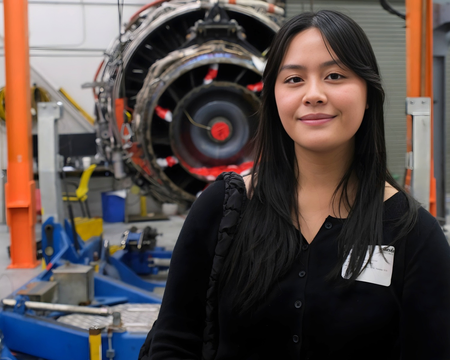
Karla La Torre Alvarez grew up in Spokane with a strong aptitude for math and science, but no clear path to make it a career. Her family had immigrated from Peru, and always encouraged her to work hard and aim high. When Washington State Opportunity Scholarship (WSOS) supported Karla’s attendance at Gonzaga University, she began to see civil engineering as a real career path.
Karla quickly became a standout student and leader at Gonzaga, and went on to earn her Master’s at the University of Notre Dame where she applied her skills to real-world problems through organizations like Habitat for Humanity. Today, Karla is a structural engineer back in Spokane, designing infrastructure that strengthens Washington communities. Inspired by his daughter, Karla’s father even went back to college to complete his own degree—precisely the kind of ripple effect that these opportunities provide.
“Karla’s path reflects exactly what WSOS aims to make possible,” says Isabel Muñoz-Colón, WSOS’ executive director. “Supporting talented students and expanding opportunity in high-demand fields across Washington state and strengthening Washington’s workforce through postsecondary education and meaningful partnerships.”
Closing Washington’s Workforce Gap #
WSOS is a public-private partnership whose mission is to help students facing the greatest barriers earn postsecondary credentials and launch careers in high-demand fields: STEM, health care, and the trades. Since its founding, WSOS has operated on a model where every private dollar is matched by the state of Washington, multiplying the impact of every donor investment.
The need WSOS is addressing is significant. Washington Roundtable projects that 75% of job openings in the state through 2032 will require postsecondary credentials or training, yet attainment has stalled well below that at 40-43% for over ten years. WSOS aims to meet students where the gaps are the greatest: 62% of Scholars are students of color, 58% are women, and 68% are first-generation college students.
"Closing the gap means working more closely with our industry partners to support Scholars in identifying high-demand career pathways," says Muñoz-Colón. It also means pairing credentials with real-world experience and equipping students with the durable skills that employers increasingly need, such as communication, teamwork, problem-solving, and AI literacy.
How a Tri-Sector Collaboration Widens WSOS’s Reach #
Addressing this gap requires more than just one sector’s resources. That’s why WSOS is built on a tri-sector model that draws on the strengths of public, private, and nonprofit sectors. Muñoz-Colón shares that while public support provides scale and long-term stability, private funding adds flexibility and ability to invest in innovation. Corporate partners and board members add insight into how the workforce is changing and what skills are truly needed, helping WSOS stay connected to shifting workplace demands and provide their Scholars with real-time, in-demand training.
“Together, this shared responsibility allows WSOS to focus on outcomes, not just scholarships, and to build strong pathways from education to meaningful work,” says Muñoz-Colón.
Investing in the Full Circle #
As WSOS has grown, one gap has become clear: what happens to students after graduation? The organization had a rich trove of anecdotal success stories from Scholars, but did not have the dedicated capacity to track outcomes, sustain relationships with alumni, or tap into that network as a resource for current students. The Murdock Trust’s grant to the WSOS Foundation equipped them to hire their first-ever Alumni Engagement Manager to focus on building the bridge between where Scholars start and where they end up.
"Everyone we work with — from students and education partners to employers and legislators — wants to ensure that students earning postsecondary credentials go on to meaningful, living-wage careers," says Muñoz-Colón. "The Alumni Engagement Manager will support graduates as they transition to the workforce, facilitate opportunities for alumni to connect with one another, and create avenues for alumni to invest back into the WSOS community through volunteering and mentorship."
By better understanding alumni outcomes, WSOS can refine its programs, strengthen its partnerships with employers, and make the data-backed case that its model is working. It will also help WSOS reach students who might otherwise not see a career in STEM, health care, or the trades as possible.
For an organization built on the idea that education and opportunity should be available to anybody, the Alumni Engagement Manager is the next step in a commitment to following Scholars all the way. It will strengthen the pipeline from first steps as a student, toward a credential, to a career that provides vital services to Washington communities long into the future.